 |
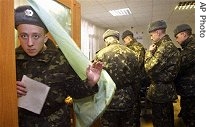
| A Ukrainian soldier holds his ballot on
leaving the polling booth at a polling station in downtown Kiev,
Ukraine, Sunday, March 26, 2006 |
Polls have
opened in Ukraine, where voters are casting ballots for a new 450-seat
parliament. The race features 45 parties, or blocs, including
those of the three main political leaders of Ukraine's so-called orange
revolution in 2004.
More than 35 million voters across Ukraine are casting ballots in an
election seen as a key test of the country's commitment to democratic
reforms.
Those visiting the polls Sunday face a difficult task, having to
select not only a party leader, or bloc for parliament, but also a
local mayor and regional assemblies.
The elections are unprecedented in that they mark the first time
voters will elect a new parliament based on a purely proportional
system using party lists. Previously, lawmakers could and often
did switch allegiances after they were elected.
 |
| President Viktor Yushchenko, left, and his
wife Kataryna, hold their ballots at a polling station in downtown
Kiev, Ukraine, Sunday, March 26, 2006 |
Sunday's ballot is also the first election to be held since pro-western reform President Viktor Yushchenko came to power.
Casting his ballot in the Ukrainian capital, Kiev, Mr.Yushchenko
acknowledged that the government had not worked well together this past
year. He said the time has come to put partisan differences aside
and work together for the good of Ukraine's future.
Mr.Yushchenko also told reporters that he would begin talks with
representatives of his former orange revolution allies as of this
Monday in Kiev.
It is not known whether similar talks will be held with forces
belonging to pro-Russia candidate Viktor Yanukovych's Party of Our
Regions, as many analysts suspect is likely.
The mere thought of President Yushchenko teaming up with his former
arch-rival, Yanukovych, has caused some in his camp to switch
allegiance. Others are simply undecided about how to cast their
vote - a factor independent analyst Ivan Lozowy
says could help boost several other smaller parties running in Sunday's election.
Certainly Alexander Moroz, the Socialist Party Chairman. He
was a former ally to Yushchenko but never formally entered the orange
coalition," Lozowy says. "Also, the protest vote and the undecideds
will boost small groups like the PORA youth-based coalition, which was
a very prominent, active participant in the Orange Revolution, but
(also) never a coalition member.
Most election-watchers agree the race will essentially come down to
three main parties. They are President Yushchenko's Our Ukraine
party, the pro-Russia Party of Regions, headed by Yushchenko's former
arch-rival, Viktor Yanukovych, and the bloc
led by Yulia Timoshenko, who was sacked as prime minister last September amid bitter infighting with Yushchenko's team.
Pre-election polls put Yanukovych well in the lead with an expected
30 percent of the vote. Mr. Yushchenko polls second with up to 20
percent, to Timoshenko's 17 percent.


 E-mail This Article
 Print Version


