 |
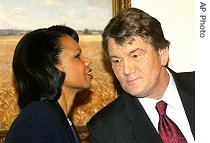
| Condoleezza Rice (l) and Viktor Yushchenko during a news conference in Kiev |
Secretary
of State Condoleezza Rice held talks in Kiev with President Viktor
Yushchenko and other top Ukrainian officials, pledging to continue U.S.
support for the country as an American "strategic partner." Ms. Rice
also expressed concern about legislation in neighboring Russia that
would restrict non-governmental organizations.
U.S. officials have been openly concerned that the "Orange
Revolution" that brought the reform-minded Mr. Yushchenko to power a
year ago has yet to deliver tangible benefits to the Ukrainian people.
But Ms. Rice, at a joint news conference with the Ukrainian
president, made clear the Bush administration intends to stand by his
government and continue pressing for its membership in Euro-Atlantic
institutions, starting with its stalled effort to join the World Trade
Organization.
"America of course values the friendship of Ukraine, a great
strategic partner and an important country within Europe, and that we
look forward to further work with this team, which is so committed to
democracy, so committed to Ukraine's future, and most especially so
committed to a better and more prosperous future for the Ukrainian
people," said Condoleezza Rice.
Mr. Yushchenko's first year in office has been marked by political
turbulence and few economic successes. But in his remarks at the news
session he sharply contested a reporter's suggestion that his
government is in disarray and the national economy stagnant.
He said his government had moved quickly to correct economic
mistakes of the previous government, citing a list of statistics
showing economic growth returning. He also said remaining obstacles to
World Trade Organization membership for Ukraine are more procedural
than substantive and said the accession process could be complete
within a few months.
On another matter, Secretary Rice stressed American concern over
legislation in the Kremlin-controlled Russian parliament, the Duma,
that would sharply restrict the activities of non-governmental
organizations.
She said the United States has expressed its concern to Russian
authorities "at all levels" over the legislation she said could
threaten Russia's democratic future:
"The role of non-governmental organizations that have been working
in Russia and other newly-independent states of the former Soviet Union
are simply trying to help citizens to organize themselves better, to
petition their government, to make changes in the policies that effect
their daily lives," she said. "That is the essence of democracy. We are
making the case to the Russian government. We are also making the case
to other places as well."
Ms. Rice said a healthy civil society in Ukraine is one reason the
United States has such hope and optimism for that country's future. The
Russian legislation has had only one of the three required readings in
the Duma.








 E-mail This Article
 Print Version


