Ukraine's Constitutional Court has begun
hearings in the capital, Kyiv, Tuesday on the legality of President
Viktor Yushchenko's decree, dissolving parliament and calling new
elections. The court is taking up the case one week later than planned,
after several judges asked for protection, alleging that political
pressure was being exerted against them. VOA's Lisa McAdams in Moscow
has more.
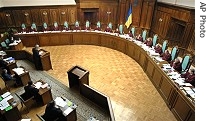 |
| Eighteen judges of Ukraine's Constitutional Court sit in judicial hall, 17 Apr 2007 |
Supporters
of Ukraine's competing political parties ringed the gates outside the
Constitutional Court, as judges got down to the high-stakes business of
trying to find a legal way out of the country's latest political crisis.
Prime Minister Yanukovych earlier filed the query with the court,
saying he believes the president's decree is unconstitutional. He has
ordered parliament to continue working until a legal decision is
rendered. His supporters have spent days camped out in the streets in
protest.
President Yushchenko, who accuses Yanukovych's Regions party of
trying to usurp power, remains firm in his call for new elections. He
says they are the only way out of the impasse, barring a last-minute
compromise with his prime minister. The two have held several lengthy
meetings, during which both parties stuck to their entrenched positions.
All eyes and hopes are now on the court, which could deliver a ruling at any time in the next 30 days.
The question is will a constitutional court decision be able to fix
what is essentially a political problem, stemming from a long-standing
political rivalry? Kiev-based independent political analyst Ivan Lozowy
is doubtful.
"The chances are not very good that either side, if they lose, will
fold up shop and quietly go off into the night with this decision.
That's the big problem," he said. "Even if the decision goes through -
let's say the elections are held, or they are cancelled, the political
fight will continue. There's no question."
The way in which that fight materializes could pose Ukraine's next
challenge. For example, Lozowy notes that - even though both parties
have said they will respect and abide by the court's decision - either
party could still change their mind and reject the outcome.
Lozowy adds he is especially unsure whether Yanukovych will keep his
word, given his recent comment to a reporter that he was ready to
launch impeachment proceedings against the president, if the court
decides in his favor.
The court is comprised of six judges chosen by the president, six
chosen by parliament, and six by the legal community. However, in the
days leading up to the hearings, five judges decided to boycott the
process, citing "gross" pressure. Three were Yushchenko appointees, one
judge was appointed by parliament and one was from the legal community.




 E-mail This Article
 Print Version


